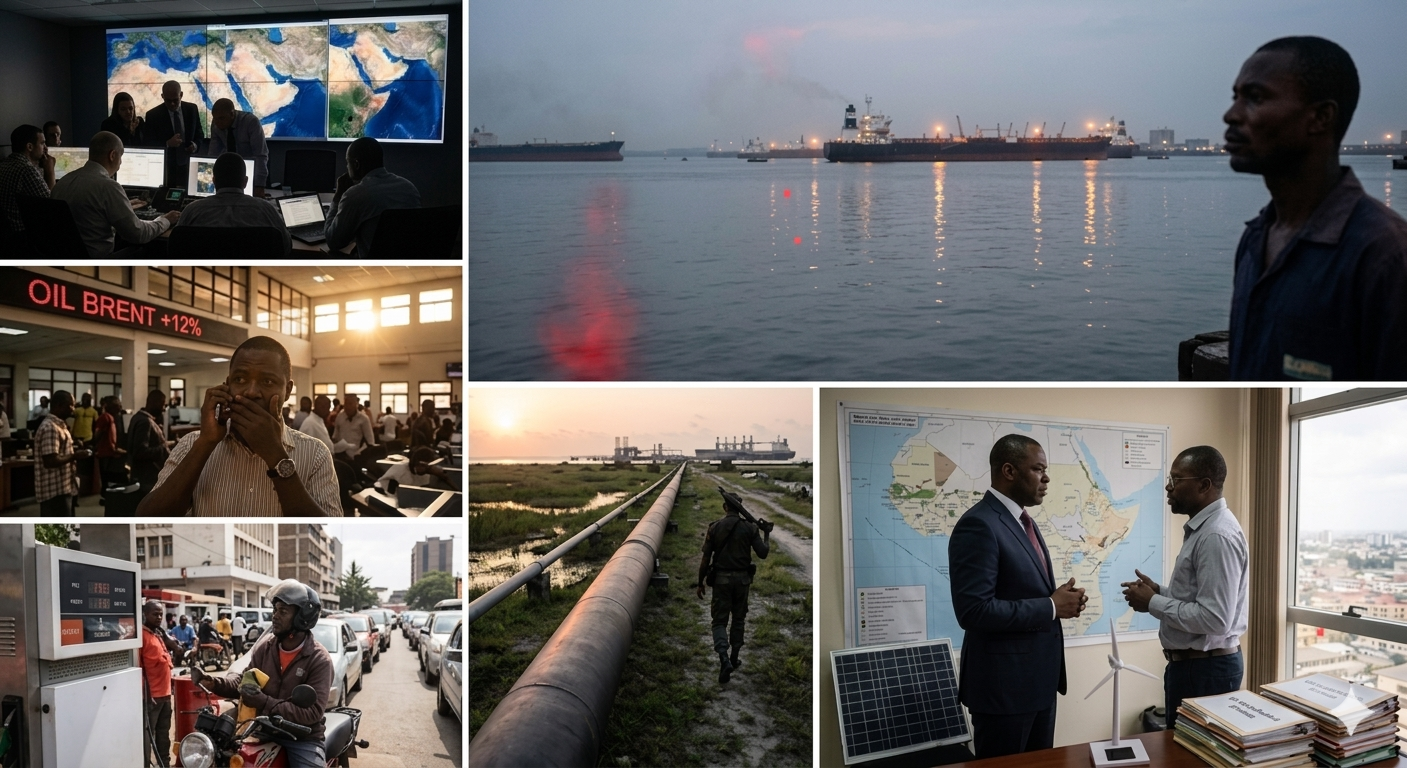
Picture this: you wake up in Lagos on a Tuesday morning, and your usual keke fare has gone up by 50 naira. The bread costs more. Your landlord sends a message about rising generator costs. You're not in a war. You're not anywhere near Iran. But the war is already in your pocket.
That's the reality of what's unfolding right now. Since the United States and Israel launched military strikes against Iran in late February 2026, an operation the US military codenamed "Operation Epic Fury," a conflict that began in the Persian Gulf has sent economic shockwaves radiating outward. And Africa, a continent with 1.4 billion people and dozens of fuel-dependent economies, is sitting directly in the path of those shockwaves.
Here is what's happening, why it matters, and what it means for African nations: the ones who will lose, the ones who might gain, and the ones stuck somewhere in between.
First, let's talk about that strait
The Strait of Hormuz is a narrow waterway between Iran and Oman, about 33 kilometres wide at its narrowest point. It doesn't look like much on a map. But roughly 20% of the world's oil supply passes through it every single day. One in five barrels. Tankers loaded with crude oil from Saudi Arabia, Iraq, Kuwait, the UAE, and Iran itself travel through it constantly, heading for refineries in Asia, Europe, and beyond.
When Iran closed the Strait at the start of the war, the International Energy Agency called it "the greatest global energy security challenge in history." That's not an overstatement. Within days, Brent crude oil prices surged 10 to 13 percent. Within weeks, analysts at Bloomberg and Morgan Stanley were warning that prices could hit 100, even 200 dollars per barrel if the disruption held. And while a ceasefire has technically been in place since April 8, the strait has not returned to anything close to normal traffic levels.
"The pain of that shock is unevenly distributed. For fuel and food-importing states in Africa, the same shock arrives more swiftly, in the form of higher household prices, fiscal strain, and a greater risk of rationing or unrest." -World Economic Forum, March 2026
The ceasefire, such as it is, remains fragile. As of today, Tuesday, April 21, Trump has extended the truce but ordered the US Navy to continue its naval blockade of Iranian ports. Iran says the blockade itself violates the ceasefire. Both sides have accused each other of breaches. Talks in Islamabad collapsed last week. Analysts are not optimistic that this will be resolved quickly.
Which means the pressure on global oil markets isn't going away. And Africa will continue to feel it.
The countries that are hurting
Let's start with the honest truth: for most African countries, this war is a painful story, not a profitable one.
South Africa is already paying more at the pump. A fuel price increase across all grades was confirmed within weeks of the war starting, driven by higher global crude prices and a weakening rand. Tanzania announced similar increases, with diesel recording its sharpest rise. Senegal's prime minister chaired an emergency meeting to secure fuel supplies and protect vulnerable households. Egypt's President el-Sisi described his country's economy as being in a "state of near-emergency," warning of growing inflation.
Ethiopia is in a particularly precarious position. The country imports the vast majority of its refined petroleum from the UAE, Saudi Arabia, and Kuwait, all Gulf states whose supply chains have been severely disrupted by the closure of the strait. Since Ethiopia produces no commercial crude oil of its own, it has almost no buffer. Analysts are projecting severe price shocks. And to make matters worse, the Iran crisis has quietly frozen the long-running diplomatic talks over the Grand Ethiopian Renaissance Dam. The major mediating powers, including the US, UN, and African Union, have simply had no bandwidth for it.
Djibouti's finance minister put it plainly. Small states that depend on maritime trade, he warned, "risk being pulled into deeper economic uncertainty as external shocks ripple across the region and Africa." He was speaking in early March. Since then, the situation has only deepened.
And there's another blow that almost nobody is talking about: fertiliser. The Gulf is a major artery for urea, ammonia, and nitrogen-based fertiliser inputs. Disruption to those supply chains has already pushed urea prices up by around 30 percent. For sub-Saharan Africa's farming communities, who are right in the middle of planting season decisions, that means higher costs, tighter margins, and in some cases reduced planting. The food security consequences could be felt by the end of 2026.
The countries with an unlikely opportunity
Here's the part the financial press has been quietly noting, even if African governments haven't said it loudly: some African oil producers are sitting on a moment.
Nigeria and Angola are the continent's two largest crude oil producers. Both export crude oil priced in international markets. When global oil prices surge, and they have surged dramatically since February, every barrel Nigeria or Angola sells is worth considerably more. The revenue windfall, in theory, is real.
The question, as always with African oil economies, is whether that windfall reaches the people. Nigeria's history with oil booms is not exactly reassuring on this front. The government has already been in dispute with the World Bank over accusations of hidden spending and diverted federation revenue, accusations the Finance Ministry denies, but which landed in the news just this week. Angola faces its own governance questions.
Still, the macroeconomic reality is that Nigeria and Angola have an opening here. If the war continues and prices remain elevated, both governments will have larger fiscal headroom than they've had in years. The pressure is on them to use it wisely: to shore up fuel subsidies for their own populations, invest in refining capacity, and resist the temptation to simply absorb the windfall into government recurrent spending.
African airlines: the invisible casualty
There is one sector of African economies that has not received nearly enough attention in coverage of this crisis: aviation.
African airlines depend heavily on Middle Eastern transit hubs, Dubai, Doha, and Abu Dhabi, as connection points for flights to Asia, Europe, and beyond. With airspace closures, damaged infrastructure, and severely disrupted operations at Gulf airports, many African carriers have been forced to suspend or reroute connections to the region. That means longer flights, higher jet fuel costs, more expensive tickets, and, in some cases, stranded citizens.
For a continent where aviation is already expensive and connectivity is already a barrier to business and tourism, this is a serious additional blow. It is also one that will outlast the immediate crisis. Rerouted flight networks and disrupted airline partnerships take time to rebuild.
What Africa's leaders are doing about it
South Africa's President Cyril Ramaphosa has signalled that South Africa would be willing to play a mediating role in the conflict if asked. It's a meaningful gesture from the continent's most institutionally capable state, and it fits within South Africa's broader post-apartheid foreign policy tradition of peaceful diplomacy. But meaningful mediation requires both sides to want it, and right now, neither the US nor Iran appears ready to let African diplomacy into the room.
The African Union, meanwhile, has been largely absent from the conversation. This is not surprising given that AU diplomatic energy has already been stretched thin by the Sahel crisis, the Sudan war, and ongoing tensions in eastern DRC. But it is a reminder of just how little structural influence the continent has when the world's great powers decide to go to war in a region that controls a fifth of the global oil supply.
What individual African governments can do is limited. Some, like Senegal, are moving to secure emergency fuel supplies. Others are implementing consumption restrictions. The most exposed, landlocked, import-dependent, with thin foreign reserves, have the fewest options and the most to lose.
The bigger picture
Here is what this war is really exposing about Africa's economic position in the world.
The continent holds enormous natural resources: oil, gas, critical minerals, arable land. It has a young, fast-growing population. It has the world's largest free trade area in the AfCFTA. And yet, when a war breaks out in the Persian Gulf between two non-African powers, African governments are essentially spectators to a crisis that is already reshaping their citizens' daily lives.
The fertiliser shock could reduce crop yields across sub-Saharan Africa later this year. The fuel shock is raising transport costs for goods that millions of people depend on. The aviation disruption is adding friction to business travel and trade. And all of this lands hardest on ordinary people, the ones who can least afford it.
The World Economic Forum put it with unusual directness in March: "What begins as a battlefield shock hardens into a geoeconomic one." Africa didn't start this war. Africa has no seat at the table where it ends. But Africa will be paying for it for years.
Nigeria and Angola have an opening, but Africa's history with oil booms is a cautionary tale. The question isn't whether the windfall arrives. It's whether it reaches the people.
What to watch in the coming weeks
Three developments will shape how this story unfolds for Africa specifically:
First, whether the Strait of Hormuz reopens fully. A genuine ceasefire that restores normal shipping would bring oil prices down and ease the immediate pressure on fuel-importing African nations. The longer it stays disrupted, the more structural the damage becomes.
Second, how Nigeria and Angola manage their revenue windfall. If either government uses this moment to invest in domestic refining, reduce import dependency, or shore up social spending, it could be a turning point. If the money disappears into recurrent spending and corruption, the opportunity will be lost, as it has been before.
Third, whether the fertiliser shock translates into a food security crisis by the harvest season. This is the sleeping giant of this story: underreported, slow-moving, and potentially more damaging to more people than the fuel price spike.
BreakingPoint News will be tracking all three.
The US-Iran war is not Africa's war. But its costs are Africa's costs. Stay with BreakingPoint News as this story develops.

Leave a comment
Your email address will not be published. Required fields are marked *