
BreakingPoint News: Africa & Beyond
Africa · Canada · Immigration · 2026
Why Africans Are Leaving Canada in 2026
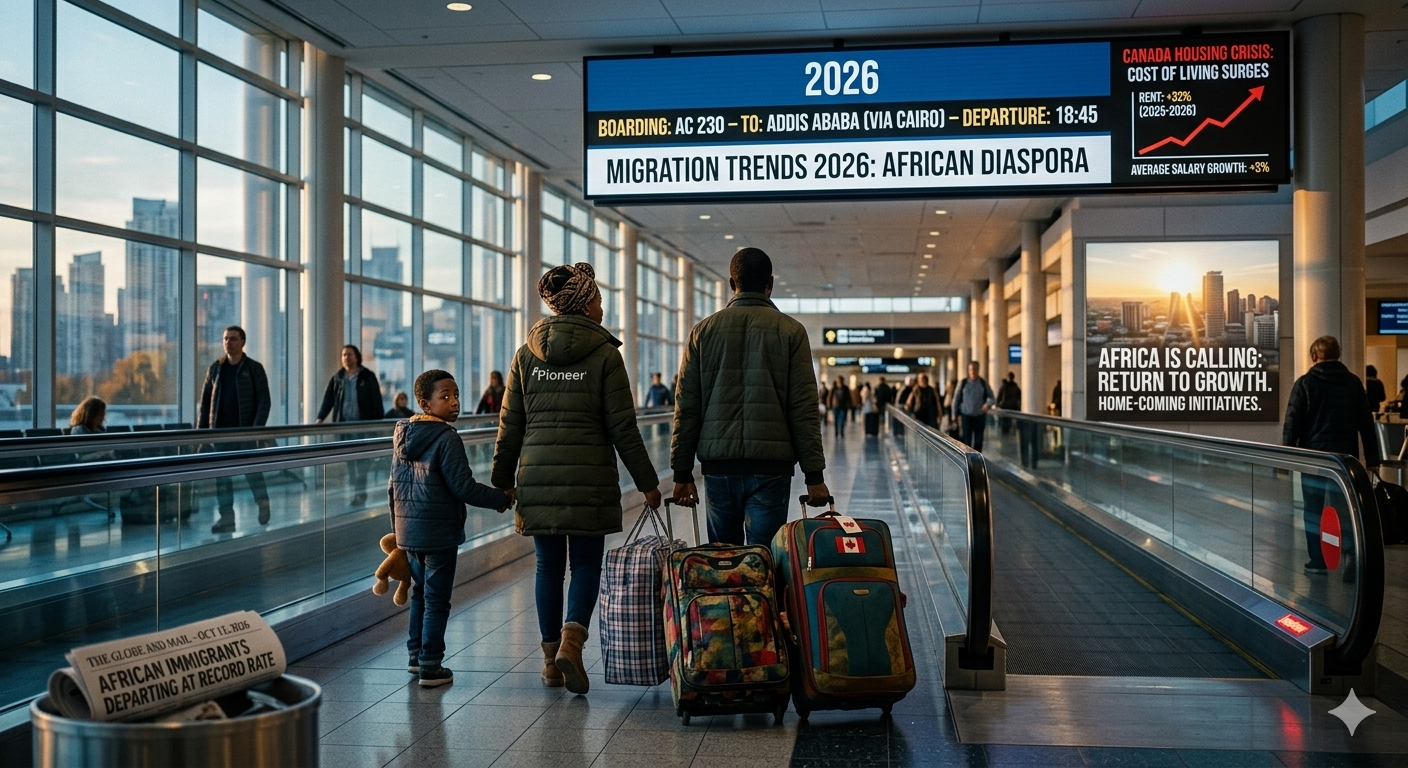
The dream promised inclusion. The reality delivered overcrowded housing, rejected credentials, and a quiet but growing exodus.
Canada sold the African immigrant a beautiful story. It was a country of opportunity, multiculturalism, and cold winters worth enduring for a better life. Hundreds of thousands came. Nurses, engineers, entrepreneurs, and teachers. They arrived with degrees, ambition, and a belief that hard work would be rewarded. For many, it has not been. And now, quietly but unmistakably, they are leaving.
The numbers are stark. The Leaky Bucket 2025, a landmark report from the Institute for Canadian Citizenship and the Conference Board of Canada, confirms what African communities across Toronto, Calgary, and Vancouver have long known: Canada is losing the very immigrants it spent the most effort recruiting.
1 in 5
Immigrants leave Canada within 25 years of landing, with departures peaking in the first five years after arrival. Highly skilled immigrants are twice as likely to leave as lower-skilled arrivals. (The Leaky Bucket 2025, ICC & Conference Board of Canada)
For Africans, who overwhelmingly arrive as skilled professionals, international students, and economic migrants, this data hits close to home. So why are they going? And more importantly, where are they going?
1. The Housing Crisis Has a Race Problem
Canada's housing crisis is no secret. But its unequal burden on Black and African immigrants is a story that rarely makes the front page. Research from the BC Policy Institute paints a damning picture of what Africans encounter the moment they begin looking for a place to live.
267%
more likely. That is the increased probability that a newcomer man with a racialized accent will face discrimination when searching for a rental unit compared to his white counterpart. (BC Policy Institute, 2025)
Beyond individual discrimination, the systemic picture is equally troubling. Black, Arab, and Latin American households face homeownership rates more than 26 percentage points below the national average and more than 30 points below white households. Black homes are valued at 30% less than comparable white homes. A quarter of recent immigrants live in unsafe, overcrowded, or unaffordable housing, compared to just 10% of non-immigrants.
"Houses and even rent are very expensive in Canada, especially for immigrants who go to the larger metropolitan areas."
— Immigration News Canada, reverse migration analysis
For Africans who arrive expecting the Canada of the immigration brochure, discovering they are spending 60 to 70% of their income on housing, often in shared accommodations they are overqualified to be living in, is a profound disillusionment.
2. Your Degree Doesn't Travel Well, Unless You're From Certain Places
One of the most repeated grievances among African immigrants in Canada is credential non-recognition. A doctor trained in Ghana, Nigeria, or Kenya, countries with rigorous medical programs, often finds herself working as a personal support worker, unable to practice because Canadian licensing bodies do not recognize her qualifications. An engineer from Ethiopia, a lawyer from South Africa, and a pharmacist from Senegal: the story repeats itself across professions and nationalities.
This isn't anecdotal. Research has consistently found that many immigrants arrive to discover their professional skills are not transferable in the Canadian labour market. This is a phenomenon that has left generations of African professionals settling into ethnic enclaves or taking jobs well below their qualification level.
📌 The Cost of Credential Rejection
The Leaky Bucket 2025 found that highly skilled workers in TEER 0 to 3 occupations, including engineering, ICT, business management, and healthcare, are more thantwice as likely to leave Canadaas lower-skilled workers. This directly correlates with credential non-recognition: when Canada won't use your skills, you find somewhere that will.
The U.S., Australia, the UK, and increasingly Gulf countries like the UAE and Saudi Arabia are actively courting these rejected professionals with faster credential recognition processes and significantly higher salaries. For a Nigerian software engineer turned Canadian food delivery driver, the math eventually becomes unavoidable.
3. Canada's Immigration Policy Has Turned Cold
The policy environment has shifted dramatically in just a few years. Canada, which once positioned itself as the world's most welcoming immigration destination, has significantly tightened its approach:
Slashed Permanent Resident Targets
PR targets were cut to 395,000 in 2025 and further to 380,000 in 2026, a 20% drop from recent peaks that left thousands of in-Canada applicants in limbo.
International Student Caps
Study permits were cut by 35%, directly affecting African students, particularly from Nigeria, Kenya, Ghana, and Zimbabwe, who had planned post-graduation pathways to residency.
PGWP Rule Changes
Stricter Post-Graduation Work Permit rules have narrowed pathways that many African graduates relied upon to transition from student to permanent resident.
TFW Program Restrictions
Low-wage worker hires were capped at 10% of an employer's workforce, directly impacting African workers who entered through the Temporary Foreign Worker program.
The message, intentional or not, has been received: Canada is less interested in you than it was five years ago. When that message reaches communities that already feel marginalized, many decide their energy is better invested elsewhere.
4. Anti-Immigration Sentiment Is Growing, and It Has a Colour
In January 2026, an anti-immigration protest in Toronto turned violent. Led by the Canada First Movement, it drew between 200 and 300 participants who gathered explicitly to demand a reduction in immigration. Counter-protesters also mobilized, but the message was not lost on African communities watching from their living rooms.
This is not happening in isolation. Research from Policy Options notes that while public surveys claim Canadians are more pro-immigration than ever, recent practices tell a different story. This includes heightened surveillance of select immigrant populations, intense scrutiny of their financial resources, and documented hate crimes against immigrant groups. The irony is sharp: Canada pitches itself as a multicultural utopia while the systems immigrants interact with daily often reflect something different.
"Immigration is never purely economic. Immigrants also attempt to escape conflict, discrimination, and political instability in their home countries. This is important to remember when assessing what Canada owes them."
— Policy Options, IRPP analysis on racism in Canadian immigration
For Africans who left countries where their identity was never in question, where they were not a "visible minority," the daily experience of being racialized is exhausting in a way that is difficult to fully communicate. Many describe a fatigue: not hatred of Canada, but a wearing down that accumulates quietly until one day you book a flight home.
5. Africa Is No Longer the Africa they left.
Perhaps the most underreported driver of the exodus is not what is pushing Africans out of Canada. It is what is pulling them back home.
Africa's economic story in 2026 is fundamentally different from the one that drove the first wave of immigration to Canada in the 1990s and 2000s. Cities like Lagos, Nairobi, Accra, Kigali, and Johannesburg have exploded with tech hubs, startup ecosystems, real estate booms, and a growing middle class hungry for professional services. The African Continental Free Trade Area has opened cross-border economic opportunities that didn't exist a decade ago. A Nigerian or Kenyan professional returning home in 2026 is returning to a market where their skills are genuinely premium assets. Their foreign-accented English, Canadian network, and international experience are all in demand.
🌍 The New Calculus for African Professionals
A doctor returning to Ghana can set up a private practice serving a growing middle class. A software engineer returning to Nigeria can join or found a startup in one of the world's fastest-growing fintech ecosystems. A lawyer in Nairobi can build a boutique firm serving a continent-wide market. The math, increasingly, favours going home.
There is also a cultural dimension that rarely surfaces in immigration statistics. Many African immigrants describe a profound longing, not nostalgia exactly, but a hunger for belonging that Canada, for all its politeness, cannot always provide. The ability to walk into a room and not be "the African" or "the immigrant." To be surrounded by family, by community, by food that does not require a two-hour drive to a specialty store. These things matter, and for a growing number of Africans, they matter more than a Canadian passport.
6. The Brain Drain Numbers Confirm It
The Leaky Bucket 2025 report represents a rare moment of official acknowledgment that Canada has a retention problem, not a recruitment problem. The findings are devastating in their precision:
1 in 5 immigrants leave within 25 years
The rate is worsening for the most recent cohorts, particularly those who arrived after 2015.
Critical sectors haemorrhaging talent
Engineers, healthcare professionals, ICT specialists, and senior managers are departing at twice the rate of lower-skilled workers. These are the exact professions Canada needs most.
$20,000–$50,000 lost per departure
That is the estimated public investment in processing and integrating each immigrant who ultimately leaves. It is an enormous fiscal cost, beyond the human one.
As the Institute for Canadian Citizenship's CEO Daniel Bernhard put it bluntly, "Canada wins when talented people choose to play for our team. But this research shows that too many of the people we most need are packing up and leaving."
What Happens Next?
Canada is facing a choice it has been slow to acknowledge. It can continue to pour resources into attracting immigrants while doing nothing substantive about the systemic barriers that drive them away, including housing discrimination, credential rejection, and institutional racism. Or it can choose retention as seriously as it has always chosen recruitment.
For Africans on the ground, however, that policy conversation feels distant. The immediate reality is a community making individual decisions: stay and keep building, or leave and start fresh somewhere that wants you as you are.
Many are choosing to leave. And they are not going quietly. They are going with degrees, skills, networks, and hard-won international experience that Africa's booming economies are ready to absorb.
Canada's loss is, increasingly, Africa's gain.
More Stories From the African Diaspora
BreakingPoint News covers Africa's stories with the depth and honesty they deserve.

Leave a comment
Your email address will not be published. Required fields are marked *