
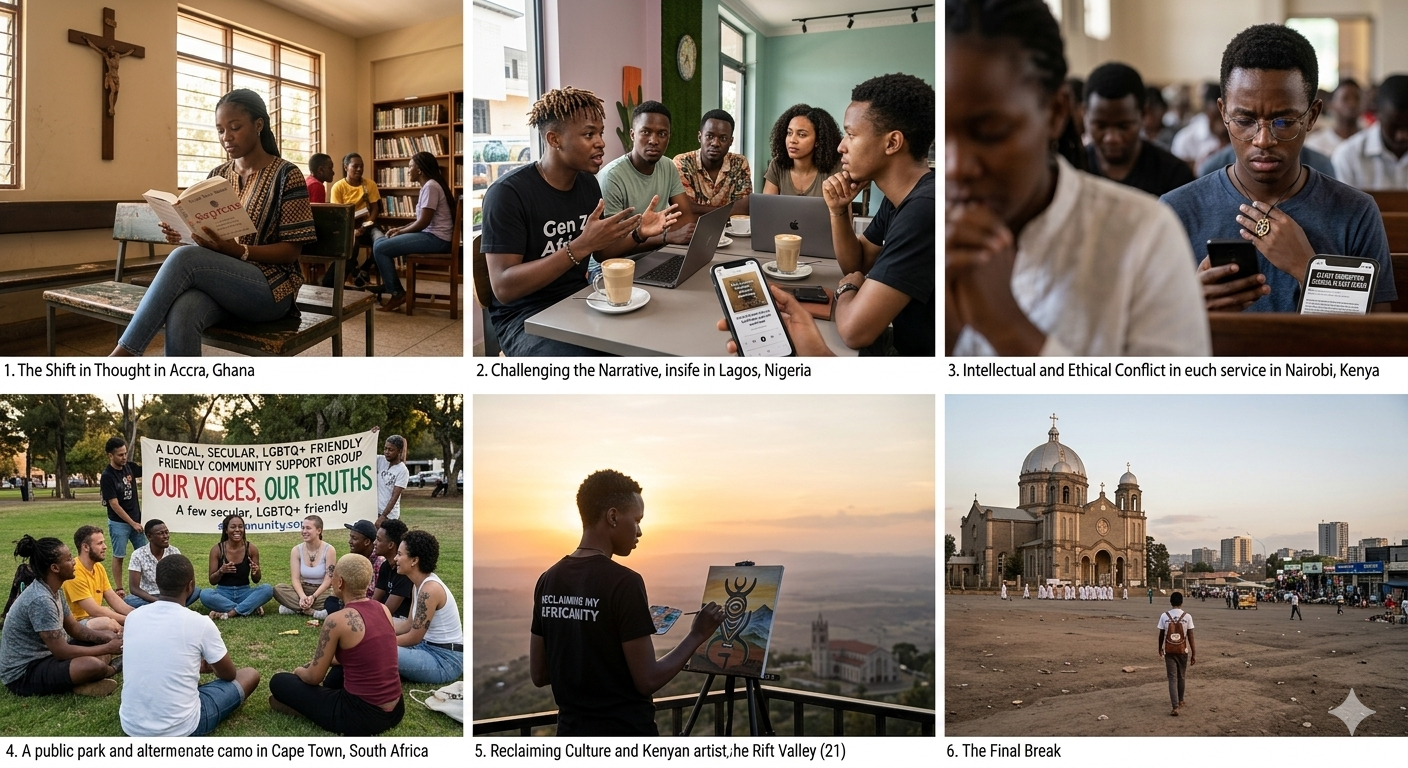
They are not storming out in anger. Most of them say nothing at all. They simply stop going. They stop praying aloud at dinner. They stop posting Bible verses on their Instagram stories. They stop believing in the God they were handed, even if they are not yet sure what they believe instead.
This is the silent religious exodus of Gen Z in West Africa. While the numbers may not yet show a dramatic statistical collapse, the conversations, the social media threads, and the university dining hall debates tell a story that official church attendance figures cannot fully capture. A generation is reckoning with its faith. And for many of them, the reckoning is ending in departure.
1. The Church Broke Their Trust First
Ask a young Nigerian why they left the church, and more often than not, the first thing they mention is not theology. It is a person. A pastor. A leader they trusted completely who turned out to be something else entirely.
In March 2026, Nigeria experienced what observers described as an unusual concentration of scandals involving religious leaders within a single month. The country has long been home to some of the largest and most influential churches in Africa, with pastors occupying positions that extend far beyond spiritual leadership into politics, business, and social life. The events of early 2026 were not isolated. They landed on top of years of accumulated distrust.
A Voice from Lagos
"I watched my mother give money we did not have to a pastor who drove a car that cost more than our house. He told her it was a seed. He told her God would multiply it. He told her this for fifteen years. Nothing multiplied except his properties."
Nigerian woman, 24, shared on X (Twitter)
The story this young woman describes is far from unique. Research published in the African Journal of Pentecostal Studies in 2024 documented the methods used by some Pentecostal leaders to amass wealth at the expense of their followers. The study identified elaborate seed-sowing schemes, prophetic extortion, and the commercialisation of spirituality through the sale of anointing oils, miracle stickers, and exorbitant fees for prayer sessions as widespread practices within certain Pentecostal circles in Nigeria.
For older generations, these practices were endured, explained away, or simply accepted as the cost of faith. For Gen Z, they are a reason to leave.
The difference is the internet. A 23-year-old in Accra in 2026 can pull out her phone and watch a BBC documentary detailing serious allegations against a celebrated Nigerian televangelist. She can read survivor testimonies on Twitter. She can find recordings of pastors contradicting their own teachings. The information that previous generations never had access to is now available in seconds. And once seen, it cannot be unseen.
"The Nigerian state has little or no oversight over how its citizens are maltreated, exploited, or abused in the name of God. Religious leaders appear not to be accountable to the state or its laws."
Nimi Wariboko, theologian and author of Nigerian Pentecostalism
For many young West Africans, this lack of accountability is the breaking point. They are not leaving God, at least not at first. They are leaving institutions they no longer trust. But for a generation raised to believe the church and God were inseparable, leaving one often leads to questioning the other.
2. Their Mental Health Needed Something the Church Could Not Give
Chisom is 22 years old and grew up in Enugu, Nigeria. She started experiencing anxiety at 17, the kind that made her chest tight in school assemblies, kept her awake replaying conversations, and made crowded churches feel like slow suffocation. She told her mother. Her mother told the pastor. The pastor told her to pray more and fast longer.
"I was praying six hours a day," she said. "And I was still falling apart. So either God was not listening, or what I had was not a spiritual problem. I chose to believe it was not a spiritual problem. That was the beginning of the end for me."
Chisom's experience is far from unique. Research published in 2025 found that among adolescents in Nigeria and Ghana, anxiety and depressive symptoms are significantly prevalent. In Ghana the rate sits at 17.6% for anxiety and 19.6% for depressive symptoms. In Nigeria the figures are 13.2% and 13.7% respectively. These are young people who are genuinely struggling, and in West Africa, the dominant response from religious communities has historically been to frame mental illness as a spiritual failure.
of young adults in Nigeria and Ghana are facing a mental health crisis, according to a 2026 Sapien Labs global report. Researchers identified weakened family bonds and declining spirituality as contributing factors, alongside early smartphone use and poor diet.
Depression is called demonic oppression. Anxiety is called a lack of faith. Therapy is dismissed as a Western concept that replaces the Holy Spirit. Young people who go to their pastors for mental health support are often told to give more, pray more, and trust more. When that does not work, the problem is framed as a personal spiritual failing rather than a medical reality that deserves proper care.
For a generation that has grown up with more access to mental health information than any before them, being told that their depression is evidence of sin is not just unhelpful. It is damaging. And it is pushing them out of churches and into therapy offices, secular support groups, and honest conversations with friends who do not require them to spiritualise their pain.
A Voice from Accra
"My church told me my depression was because I had not fully surrendered to God. I had been saved, baptised, and in church three times a week since I was six years old. At some point I had to ask myself: if full surrender looks like this, maybe the problem is not me."
Ghanaian man, 26, speaking to a mental health community forum
What makes this particularly painful for many young West Africans is that faith was genuinely central to their identity growing up. It was not something imposed from the outside. It was woven into how they understood themselves, their families, and their futures. Walking away from it does not feel like freedom, at least not at first. For many, it feels like grief.
3. Education Taught Them to Ask Questions the Church Could Not Answer
Kwame grew up in Kumasi, Ghana, in a deeply Pentecostal household. His parents named him after a grandfather who had converted to Christianity in the 1960s. Faith was not a Sunday activity in his home. It was the air they breathed. Then Kwame went to university to study biology.
"I was not trying to lose my faith," he said. "I was just learning. And the more I learned, the more questions I had. I brought those questions to my pastor. He told me science was the devil's tool to make people doubt God. That was the moment I realised this church did not want me to think. It wanted me to obey."
Across West Africa, tertiary education is expanding rapidly. More young Nigerians, Ghanaians, and Senegalese are attending university than any previous generation, studying fields like medicine, engineering, law, and the social sciences. These disciplines require critical thinking, evidence-based reasoning, and a willingness to follow arguments wherever they lead. These habits of mind do not always coexist comfortably with a faith tradition that prioritises obedience, certainty, and unquestioning loyalty to pastoral authority.
A Voice from Port Harcourt
"I asked my pastor why God commanded the killing of children in the Old Testament. He said I was being influenced by the devil for asking. I was 19. I was a theology student. If a theology student cannot ask that question in church, something is deeply wrong."
Nigerian man, 23, university theology student
4. The Pastors Were Preaching Prosperity While the People Were Living in Poverty
There is a particular kind of anger that builds in a young person when they watch their family scrape together money for tithe while the pastor announces a new private jet. It is not just anger at injustice. It is the anger of betrayal, of watching someone you trusted use the language of God to take from people who could not afford to give.
Nigeria's prosperity gospel industry is one of the most powerful religious economies in the world. It has produced some of the wealthiest pastors on the planet. It has also produced millions of followers who gave generously for decades and remained poor. For Gen Z, who grew up watching their parents pour resources into churches while the country's infrastructure crumbled and the economy collapsed around them, the disconnect is impossible to ignore.
of young Africans aged 15 to 35 plan to leave their countries within three years, according to a 2024 survey by the Ichikowitz Family Foundation. Economic despair is the primary driver, the same despair that fuels the prosperity gospel and, increasingly, the disillusionment with it.
The bitterest irony is this. The prosperity gospel told young West Africans that faith was the path out of poverty. Instead, many watched their families give their way deeper into it, while the men who preached the giving built empires. For a generation that has inherited genuine economic suffering, this is not a theological disagreement. It is personal.
"Promising miracles for money creates dependency and financial strain among the most vulnerable followers. It is not faith. It is a system designed to extract wealth from people who have very little of it."
African Journal of Pentecostal Studies, 2024
5. Social Media Gave Them a Community Outside the Church
Before social media, a young Nigerian questioning her faith had very few options. She could speak to family members who would pray over her doubts. She could speak to her pastor, who would reframe her questions as spiritual weakness. Or she could suffer in silence, attending church every Sunday while privately unravelling.
Today she can open Twitter and find thousands of young West Africans having the same conversation she thought she was alone in having. She can join a Reddit community of African deconstruction stories. She can follow content creators from Lagos and Accra who talk openly about leaving the church, about spiritual abuse, about finding meaning outside of organised religion. She can realise, sometimes for the first time, that she is not broken. She is just honest.
Research published in 2025 documented how Nigerian youth are encountering increasing social commentary on religious content through targeted social media. In the post-COVID era, questions about fake miracles and questionable financial practices in churches have found a loud, public home on platforms like Twitter, TikTok, and Instagram. The secularisation of religious conversation online is happening fast, and the church has no effective response to it.
A Voice from Dakar
"I thought I was the only one who felt like a fraud in church. I thought something was wrong with me. Then I found this community online of young Africans who felt exactly the same way. I cried for an hour. Not because I was sad. Because I finally felt seen."
Senegalese woman, 21, speaking in an online faith deconstruction community
Where Are They Going?
It would be easy, and wrong, to read this as a story about a generation abandoning all spirituality. Most young West Africans who are leaving organised religion are not becoming atheists in the Western philosophical sense. They are becoming something harder to label.
Many describe themselves as spiritual but not religious. They still believe in something, a higher power, a moral universe, a sense that there is meaning beyond what can be seen and measured. But they no longer believe that this something is best accessed through a pastor who drives a Rolls-Royce, and who told their mother that her cancer was a test of insufficient faith.
Some are returning to African traditional spiritual practices, finding in them an authenticity and cultural rootedness that Pentecostalism, with its imported aesthetics and prosperity gospel economics, never quite provided. Research from the University of Nigeria documented a notable movement among young Nigerians back toward traditional religious practices in recent years.
Others are simply living with uncertainty. They are holding their questions without demanding answers. They are building ethical lives, caring for their communities, and loving their families without the scaffolding of institutional religion. For a generation that grew up being told that doubt was sin, choosing to live with doubt honestly feels, to many of them, like the most spiritual thing they have ever done.
A Final Voice, from Lagos
"I still talk to God sometimes. I am just not sure anyone is listening. But I figure an honest conversation with an uncertain God is better than a performative one with a certain lie. At least I am not pretending anymore."
Nigerian man, 25, shared in an online community
The West African church is not dying. Christianity in sub-Saharan Africa remains one of the fastest growing religious movements in the world, and official retention rates in Nigeria and Ghana remain high by global standards. But the church has a generation problem it has not yet found the language to address.
The young people leaving are not the ones who never cared. They are the ones who cared the most. They are the ones who asked questions, who noticed contradictions, who brought their pain and were told to pray harder. They are leaving not because faith failed them, but because the institution failed them.
And until the church learns to sit with that distinction honestly, the quiet exodus will continue.
More Stories Rooted in Africa
BreakingPoint News covers the stories shaping Africa and its diaspora with honesty and depth.